


What is Net Metering?
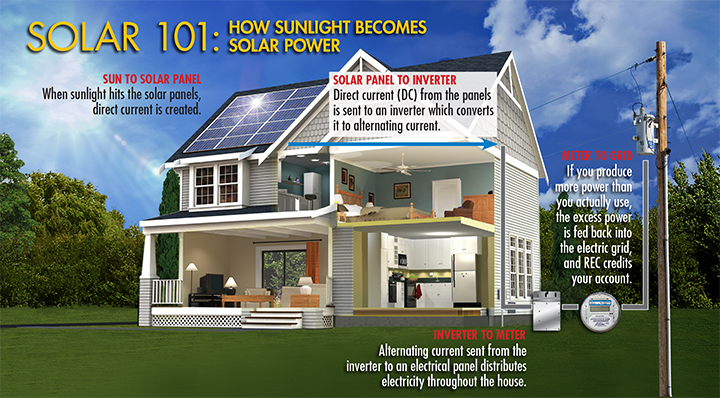
Net metering allows CEC customers with renewable energy systems to feed excess generated electricity back into the grid. The intent of a net metering arrangement is to allow the member to meet all, or part, of their electric energy requirements by using renewable fuel generation on the member’s premises.
Many solar customers produce more power than they would typically use during daylight hours; therefore, net metering provides an outlet for them to export this excess power to their utility to offset their future electric bills.
How It Works
Once an interconnection passes inspection by Community Electric a net meter will be installed. CEC will measure the electricity produced (generated) as well as the energy used (delivered) at the home. The energy that isn’t immediately used can then be applied to offset future electric bills. In Virginia specifically, members tend to produce more energy in the Spring and Fall, and less energy in the Winter and Summer.
Regulations
In Virginia, the State Corporation Commission has Regulations Governing Net Energy Metering in place.
Small Generator Interconnection
The process to interconnect a small generating facility (SGF) to Community Electric Cooperative’s electrical system is regulated by the Commonwealth of Virginia. The process is defined by 20VAC5-314 (PDF). Further guidance can be found by referring to Schedule SGI.
20VAC5-314 outlines three separate processes to interconnect and each is dependent on the generating capacity of the proposed small generating facility.
- Level 1 Interconnection Process is available to any interconnection applicant proposing to interconnect a SGF no larger than 500 kW to the Cooperative’s system.
- Level 2 Interconnection Process is available to any interconnection applicant proposing to interconnect to the Cooperative’s system a SGF no larger than 2 MW and not qualifying for the Level 1 process.
- Level 3 Interconnection Process is available to any interconnection applicant proposing to interconnect to the Cooperative’s system a SGF no larger than 20 MW and not qualifying for the Level 1 process or Level 2 process.
For more information concerning small generator interconnects or to submit an application, please call or email Scott Smith, Manager of Engineering.
System Net Energy Metering Capacity
As of January 1, 2023.
| System Peak | Megawatts |
|---|---|
| Base System Peak | 78.9 |
| Less any CSP or MBR Service | 0 |
| Total System Peak Available for NEM | 78.9 |
| Cap | Megawatts |
|---|---|
| Total Residential Cap (2%) | 1.57 |
| Total Nonresidential Cap (1%) | 0.78 |
| Total Nonprofit & Nonjurisdictional Cap (2%) | 1.57 |
| System | Capacity Installed |
|---|---|
| Total Residential Capacity Installed | 1.058 MW |
| Total Nonresidential Capacity Installed | 0.053 MW |
| Total Nonprofit & Nonjurisdictional Capacity Installed | 0.0 MW |
| NEM Capacity | Capacity Available |
|---|---|
| Total Residential Capacity Available | 0.512 MW |
| Total Nonresidential Capacity Available | 0.727 MW |
| Total Nonprofit & Nonjurisdictional Capacity Available (MW) | 1.578 MW |